Sign Up to Volunteer with Us!

Signing up to volunteer with ARC has never been easier! If you’re new to volunteering with us, we recommend signing up for our monthly volunteer email that goes out at the end of each month. You can do that by filling out the quick Google Form on the Get Involved page, or letting us know that you’re interested when filling out your POINT application. 

Whether you’ve filled out the Google Form or not, you will need to create a POINT account to be able to sign up for volunteer opportunities.

Step 1: Create A Point Account

Get started by creating a POINT account and completing the optional volunteer application here: Create POINT Account.

  • Only your birth date is required (to confirm you’re 13 or older). Feel free to fill out as much or as little as you’d like!
  • After completing or skipping the questions, click “Next” to review our short Volunteer Manual, which explains how to connect with us on your phone. Check the box to confirm you’ve reviewed it, and click “Complete Application.”
  • A confirmation email will be sent to your inbox.

Step 2: Verify Your Point Account

Make sure to verify your POINT account by clicking the link in the confirmation email. Once verified, you’ll be able to sign up for ARC volunteer opportunities!

You can view your registered events and sign up for more by logging into POINT on the web or via the mobile app. We recommend downloading the app to receive notifications about event updates or cancellations directly to your phone. Event reminders will also be sent via email and the app one week and one day before the event. To manage these updates, adjust your notification settings in your profile.

Stay Connected With ARC

  • ARC Volunteer Network: Log in to your POINT account, watch training videos, read the volunteer blog, participate in calls to action, and more. This resource was made for ARC’s volunteers!
  • Slack: A welcome email with an invitation to ARC’s Slack Team will be sent to you as soon as you sign up for the monthly volunteer email. Slack is a great resource to stay connected with ARC and other volunteers, ask questions or look for rides, get updates on upcoming events, and more! 

Monthly Volunteer Meetings

We’d love to see you at our monthly volunteer meetings, generally held on the third Wednesday of each month from 6:30 to 8:00 pm at our office and vegan boutique, Ethique Nouveau (317 W. 48th St, Minneapolis). These meetings are a great opportunity to discuss current issues, connect with others, and plan upcoming projects. All volunteer meetings are posted on POINT.

If you have any questions, don’t hesitate to reach out! Feel Free to email ARC’s Outreach Manager, Kelsey, with any questions and she will be happy to help. 

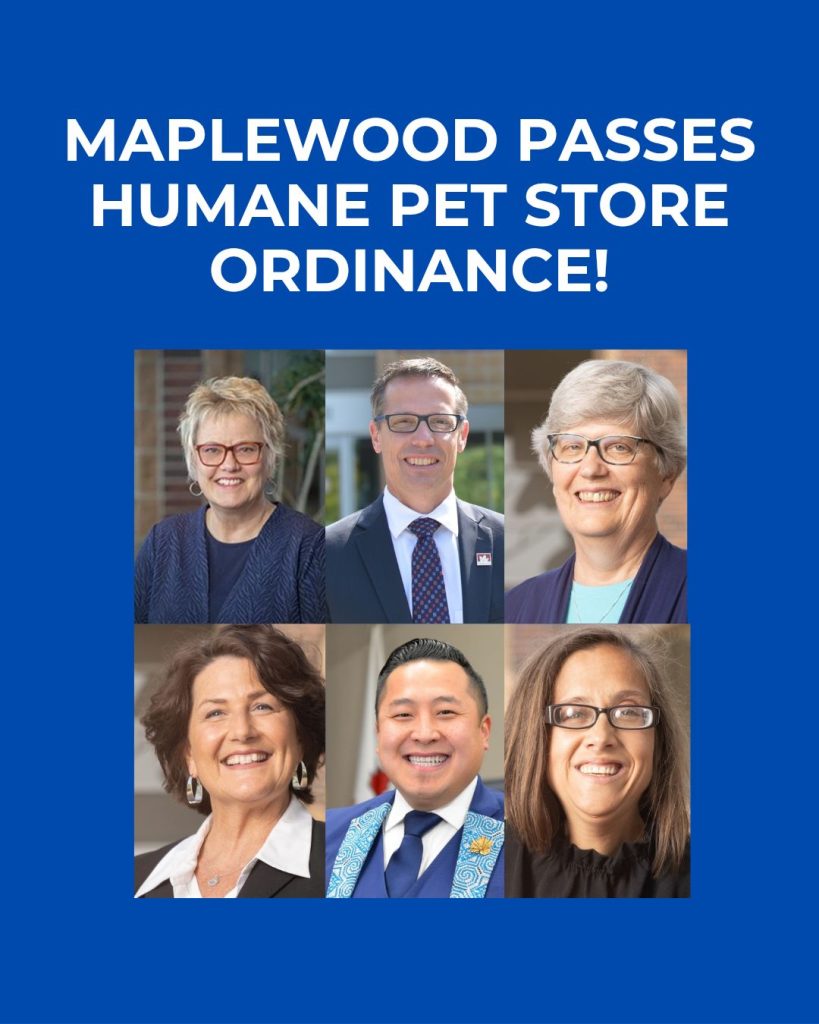
Maplewood Becomes 16th City to Pass Humane Pet Store Ordinance

Thank you to the Mayor, Council, City Manager and staff of City of Maplewood for passing a Humane Pet Store Ordinance at last night’s city council meeting! Also a huge shout out to Maplewood resident Jan Derwa for reaching out to see how she could take action for animals in her city and for following through on that 👏

These ordinances are an important preventative measure in stopping the sale of puppies and kittens from mills where the animals are seen as a product versus a sentient being. 

Maplewood joins Roseville, Eden Prairie, St. Paul, Carver, Cloquet, Minneapolis, Coon Rapids, Columbia Heights, Maple Grove, Oak Grove Park, Edina, Osseo, Shoreview, and Lino Lakes, Golden Valley. If you live in a city that’s not yet on the list and would like to help, please send us a message (animalrightscoalition@msn.com)!

A Letter to the DNR: Killing Isn’t Conservation

For most of my life, I assumed the Minnesota Department of Natural Resources existed to protect wildlife. The name implies stewardship and care. But the deeper I looked, the more disillusioned I became. In practice, the DNR does not primarily function as a guardian of wild animals; it manages them as resources to be hunted, trapped, and killed.

Each year, the DNR authorizes and promotes hunting and trapping seasons for dozens of native species. These activities are central to the agency’s mission, funding model, and public outreach. License sales and permit fees finance a significant portion of DNR operations, creating a structural conflict of interest: wildlife must be killed for the system to sustain itself.

The claim that hunters are indispensable to conservation because they pay for permits collapses under scrutiny. Hunters have a vested interest in maintaining a system built largely by and for hunters—one that prioritizes “harvestable surplus” over ecological health. Meanwhile, roughly 82% of the public does not hunt or fish, yet bears the ecological consequences of these decisions.

This model closely resembles industrial agriculture. To maximize yields of “desirable” species such as deer or game birds, predators are treated as competitors and deliberately removed. But ecosystems are not farms, and wildlife is not a crop. When top carnivores disappear, the balance they maintain disappears with them.

Predators regulate prey populations not only through killing, but by shaping behavior. Wolves, mountain lions, bears, and coyotes influence where prey feed, how long they linger, and how frequently they reproduce. Without these pressures, prey populations grow unnaturally, overbrowse vegetation, degrade habitat, and ultimately suffer from starvation, disease, and die-offs. Humans then step in to “manage” the very problems their intervention created.

Scientific evidence shows that intact predator populations are largely self-regulating. Large carnivores control their own numbers through territory, social structure, and food availability. Killing predators disrupts these natural feedback loops, locking ecosystems into a cycle of perpetual human intervention.

Removing predators does not prevent imbalance—it causes it. What is often framed as “wildlife management” is, in reality, a system designed to maintain a steady supply of animals for hunting, not to protect ecological integrity.

The numbers are staggering. In the 2024–2025 MN season alone, Minnesota hunters and trappers killed at least 979 bobcats, 648 fishers, 652 martens, and 2,497 river otters. These are elusive, slow-reproducing species with critical ecological roles, yet their deaths are recorded not as losses, but as “harvests.”

And those figures represent only a fraction of the total toll. Coyotes, beavers, foxes, raccoons, muskrats, skunks, badgers, rabbits, squirrels, and weasels are targeted. Bears, deer, elk, and wild turkeys are hunted annually. Prairie chickens, grouse, pheasants, cranes, doves, snipe, woodcock, crows, and waterfowl are killed by the hundreds of thousands. Many of these numbers are estimates, meaning the true toll is likely higher.

This is not conservation as most people understand it. True conservation prioritizes the well-being of animals and ecosystems for their own sake, not their utility to humans. It recognizes animals as sentient beings, not inventory, and favors coexistence, habitat protection, and non-lethal solutions over guns and traps.

When an agency charged with protecting nature actively encourages killing native wildlife, the word “conservation” loses its meaning. Minnesota can do better. Until the DNR shifts its priorities from killing toward genuine protection, it will remain an agency that manages wildlife for human use, not one that truly conserves it.

Minnesota’s wildlife policies are shaped by public pressure. If you believe wildlife should be protected for ecological health, not managed primarily for killing, make your voice heard.

Amy Leinen 
ARC Campaign Manager

Contact the Minnesota Department of Natural Resources: 
info.dnr@state.mn.us
651-296-6157

Sample:

Dear Minnesota DNR Leadership,

I am a Minnesota resident writing to express concern about the state’s current wildlife management approach.

While I value conservation, I am troubled that Minnesota’s system prioritizes hunting, fishing, and trapping over the protection of wildlife and intact ecosystems. Predators and other native species play critical ecological roles, yet they continue to be treated primarily as harvestable resources rather than as essential components of healthy landscapes.

I urge the DNR to end lethal management of predators and furbearers, prioritize ecosystem health and biodiversity over harvest quotas, develop funding models that do not depend on killing wildlife, and center conservation policies around coexistence and habitat protection.

Most Minnesotans do not hunt or trap, yet we all share responsibility for the state’s ecological future. I ask that the DNR better reflect the values of the broader public and the best available ecological science.

Thank you for your time and consideration.

Sincerely,
[Your Name]
[City, MN]

Fur-Free Thrift Store Outreach Update

Over the past few weeks, we’ve been connecting with local thrift stores to encourage fur-free policies and invite them to partner with our Cuddle Coats program. We hand-delivered information to shops that currently sell secondhand fur, as well as those that already choose not to, inviting them to take a public stand against the fur trade.

Our message was simple and solutions-focused: fur is increasingly out of step with today’s values, and donated fur doesn’t have to go to waste. Instead, it can be transformed into Cuddle Coats—soft, comforting garments that help orphaned and injured wildlife at rehabilitation centers and sanctuaries feel safe and secure.

Following our in-person visits, we sent mailed letters outlining the benefits of partnering with us, including positive community visibility, promotion through our channels, and the opportunity to make a meaningful, tangible difference for animals. Stores that commit to a fur-free policy and a partnership with Cuddle Coats are invited to display a Fur-Free window sign, proudly showing their values to customers and passersby alike.

We’re hopeful these conversations will lead to more fur-free storefronts and more Cuddle Coats for animals in need.

Stores we reached out to:

  • 316 Vintage
  • Arlo Boutique
  • Audrey Rose Vintage
  • b. Resale 
  • Cake Plus-Size Resale
  • Clubhouse Market
  • Fieldhouse Thrift Store
  • Love Token Vintage and Handmade
  • Moth Oddities
  • Olio Vintage
  • Queenie & Pearl
  • Rewind
  • Smile Back Vintage

If there’s a thrift store in your neighborhood you’d like us to reach out to, please let us know—we’d love your help growing this outreach (animalrightscoalition@msn.com). 

Ethique Nouveau – ARC’s Vegan Boutique & Office Space

Did you know ARC’s office is also home to Ethique Nouveau, a vegan boutique filled with snacks, cosmetics, books, clothing, jewelry, bags, wallets, and more—with every purchase supporting our work for animals?

Our space also hosts monthly volunteer meetings, in-person workshops, Cuddle Coats prep sessions, food drives, and community pop-ups. And with the holidays around the corner, Ethique Nouveau is the perfect spot to find affordable, animal-free gifts that reflect your compassion.

Don’t miss our Saturday pop-ups from 1:00–3:00 pm, where we welcome local vegan businesses who don’t have a brick-and-mortar shop. Recent businesses include Tried and True Confections, Mad Hare Vegan, Hex & Quill, Seymour Munchmore’s, Vegan Witt, Panda Squad Cookies, Just Juice, RachCakes, and many more!

Follow Ethique Nouveau on Facebook and Instagram to stay updated on pop-ups and pre-order opportunities.

Looking to support even more vegan businesses? Browse ARC’s MN Vegan Guide to discover local pop-ups, services, and plant-powered products across Minnesota!

Give to the Max: A Note from ARC’s President

“The Animal Rights Coalition has changed my life. It’s given me community, purpose, and a place to stand up for what I believe in. Through ARC, I’ve met incredible, passionate people who care deeply about creating a kinder world for animals. Together, we’ve achieved real victories — from shutting down Petland’s cruel pet store to ending fur sales at Ribnick and L.A. Rockler, and even closing exploitative operations like SeaQuest.

ARC isn’t just an organization; it’s a movement that gives animal-loving people a place to connect, take action, and make lasting change. Every donation fuels that mission — funding campaigns, outreach, and education that save lives and inspire others to do the same.

If you believe in kindness and justice for all beings, please consider donating to the Animal Rights Coalition. You’re not just supporting a cause, you’re joining a community that’s truly making a difference.”

~Ashley Riddle
President, Animal Rights Coalition

This Give to the Max Day, your compassion can go twice as far for animals.

A generous supporter has offered a $15,000 matching grant—so every dollar you give will be doubled!

Together, we can make real change for animals used for food, clothing, experiments, and entertainment. Let’s reach the match and build a kinder world.

Donating is easy! Follow the QR code or visit: givemn.org/organization/Animal-Rights-Coalition


ARC’s 2025 Minnesota State Fair Activism Recap: Shutting Down the “Miracle of Birth” Center (MOBC)

For five powerful days leading up to and during the Minnesota State Fair, Animal Rights Coalition activists took bold, creative, and compassionate action to expose the reality behind the fair’s exploitation of animals—especially those confined and used in the Miracle of Birth Center, where each year, nearly 200 baby animals, including piglets, lambs, and calves, are born in front of large crowds at the fair. Many animals are induced to give birth on schedule, and mother-newborn separation is common. This exhibit reduces birth to a spectacle without regard for the comfort and safety of the mothers and their offspring and exploits these animals for entertainment.

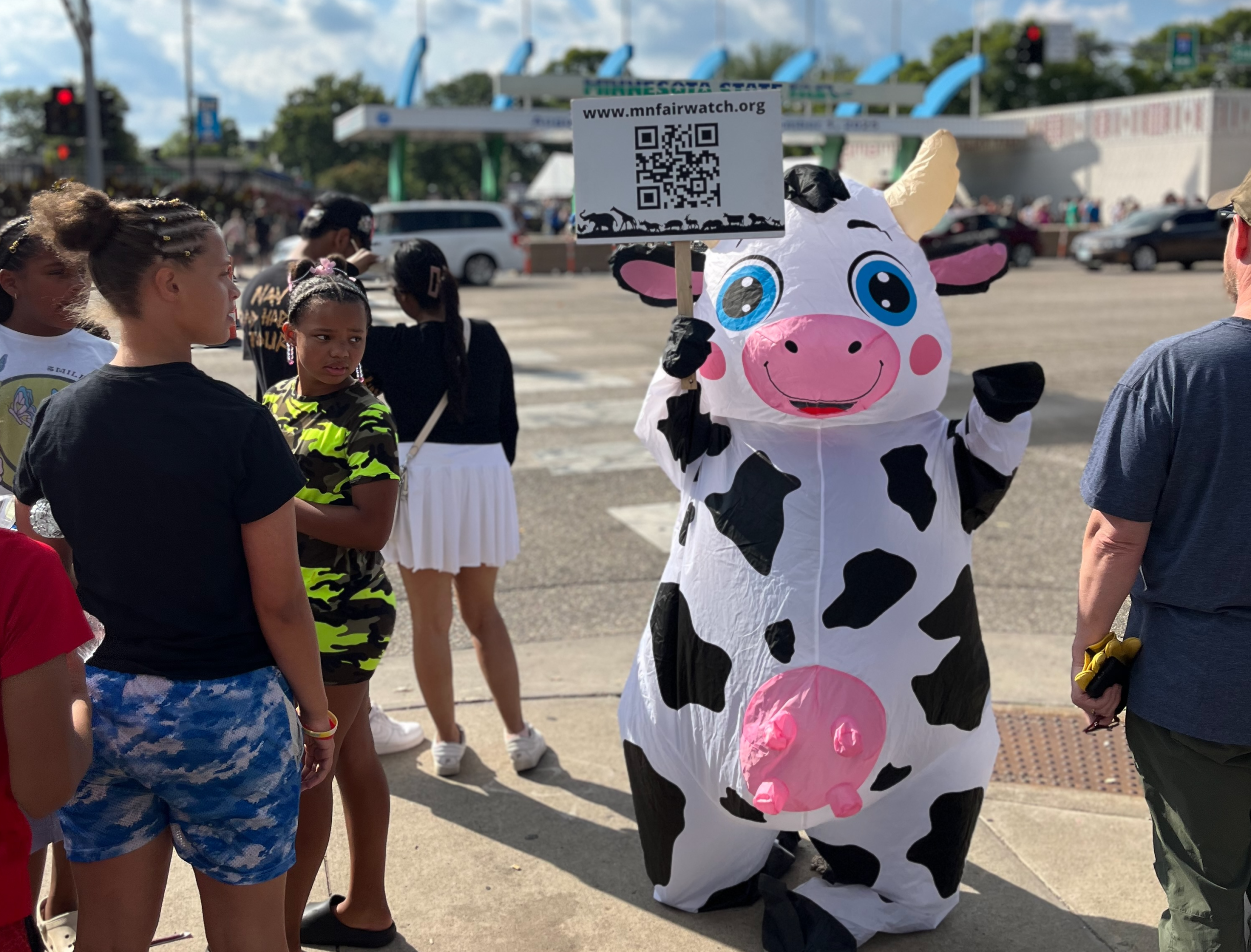
From chalktivism to banner drops, community outreach to costumed protests (special thanks to our spirited cow mascot, SoyMilk Suzy!), this year’s campaign was our largest and most impactful yet. We handed out a record number of leaflets and sparked countless meaningful conversations with fairgoers about the truth behind the fair’s portrayal of animal agriculture.

Here’s what our activism looked like:

Sidewalk Chalk Outreach
The day before the fair opened, activists filled the sidewalks with thought-provoking messages, quotes, and images—reaching fairgoers before they even stepped inside. Many of these chalk messages lasted throughout the entire fair, spreading awareness to thousands.

Protests & Literature Distribution
Outside the main gates, activists held signs, shared literature, and engaged with attendees to share our message: “MN Fair = Not Fair.” Many people stopped to learn more or voiced their agreement that the Miracle of Birth Center is a heartbreaking place for both visitors and animals.

Bridge Banner Drop
A massive six-foot banner was displayed multiple times over Highway 94, catching the eyes of rush-hour commuters and urging the public to end animal exploitation at the fair. Nearby, activists used chalk to spread positive, awareness-raising messages throughout the area.

Vibrant Costumes & Visuals
Our iconic cow mascot, SoyMilk Suzy, brought energy and visibility to our cause—drawing attention to the suffering of mother cows and their babies in the dairy industry.

Our message remains clear and unwavering: it’s time to close the Miracle of Birth Center. This deceptive exhibit normalizes animal suffering and commodification for entertainment. Birth should never be a spectacle.

We’re deeply grateful to every activist who showed up, chalked a message, held a sign, started a conversation, or stood in the heat for the animals. Together, we’re creating a future where no animal is bred, confined, or displayed for human profit.

Learn more about this ongoing campaign and how to get involved at MNFairWatch.Org.

Sign In Defense of Animals Petition to End Horrific Birthing Shows at the MN State Fair. 

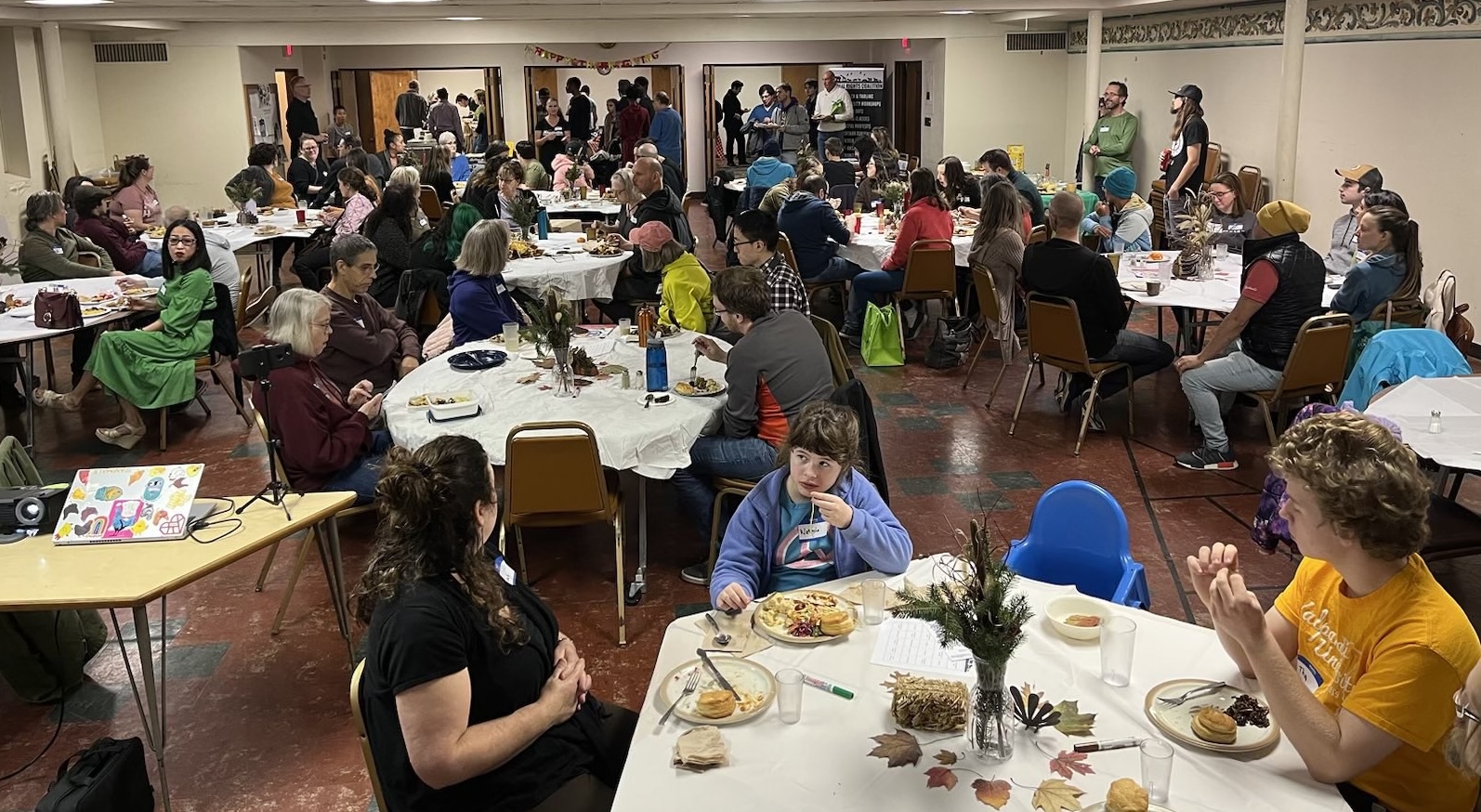
You’re Invited to ARC’s 30th Annual Vegan Friendsgiving!

Every year, ARC hosts a Turkey-Free Friendsgiving Potluck at a nearby church bountifully filled with delicious vegan food where everyone is welcome! This event has gotten so large that we’re moving locations this year. Find us on Sunday, November 9th, from 4:00-6:00 pm at Minnehaha Masonic Lodge #165, 5149 Bloomington Ave, Minneapolis, MN 55417

Beverages will be provided, along with a variety of vegan cheeses and vegan turkey roasts to sample. Bring a vegan main dish, side dish, or dessert to share, along with a serving spoon (vegan = no meat, dairy, eggs, gelatin, honey, or refined sugar). This is a wonderful event to bring your friends and family to and show them how delicious vegan holiday eating can be.

RSVP on Facebook or Meetup

Sign up to volunteer on POINT

Macalester Alum Dr. Neal Barnard Sues College Over Use of Live Animals in Labs

Dr. Neal Barnard—Macalester College alum, physician, and President of the Physicians Committee for Responsible Medicine (PCRM)—filed a lawsuit Tuesday, June 3rd, in Hennepin County District Court against his alma mater, accusing the school of misleading the public about its use of animals in undergraduate labs.

The lawsuit claims that Macalester continues to use live mice and rats in psychology lab courses, despite stating on its website that it adheres to ethical animal welfare standards. Dr. Barnard says he learned of these ongoing practices while helping to plan and raise funds for his 50th class reunion, which took place on Friday, June 6.

Barnard is demanding that Macalester either stop using animals when non-animal alternatives are available or remove public claims suggesting that the school upholds high ethical standards in its treatment of animals. If not, he wants the college to return his $100 donation and is seeking a court declaration that Macalester is in violation of Minnesota law for misrepresenting its practices online.

This lawsuit is part of a broader shift in academic science: no medical schools in the U.S. or Canada currently use animals in their teaching curriculum. “If [Macalester officials] go to court and say, ‘We have stopped all of this,’ the lawsuit will be mooted out,” Barnard said. “If they do anything else, they’ve got a fight on their hands.”

Take Action
Visit PCRM.org to learn more and send a message to Macalester College President Suzanne Rivera, urging the school to end its outdated and unnecessary use of animals in its psychology labs.

Full article in the Star Tribune:
Alum sues Macalester over animal cruelty concerns in lab experiments

Over Four Decades of Animal Advocacy

Learning lessons from the past is crucial for shaping our future. By delving into the rich history of the Animal Rights Coalition (ARC), we gain valuable insights into the struggles and triumphs that paved the way for today’s animal advocacy.

Understanding the mission and values that motivated the founders of ARC not only reminds us of their pioneering spirit but also reinforces the principles that continue to guide us today. Knowing our history helps us appreciate the depth and breadth of ARC’s impact and honors those who have led the way.

Read more about ARC’s trailblazing history advocating for animals: https://animalrightscoalition.com/history/